

Ribbons, Spring, and the Month of Mary
A childhood memory of May traditions leads to a deeper curiosity about Mary Magdalene.

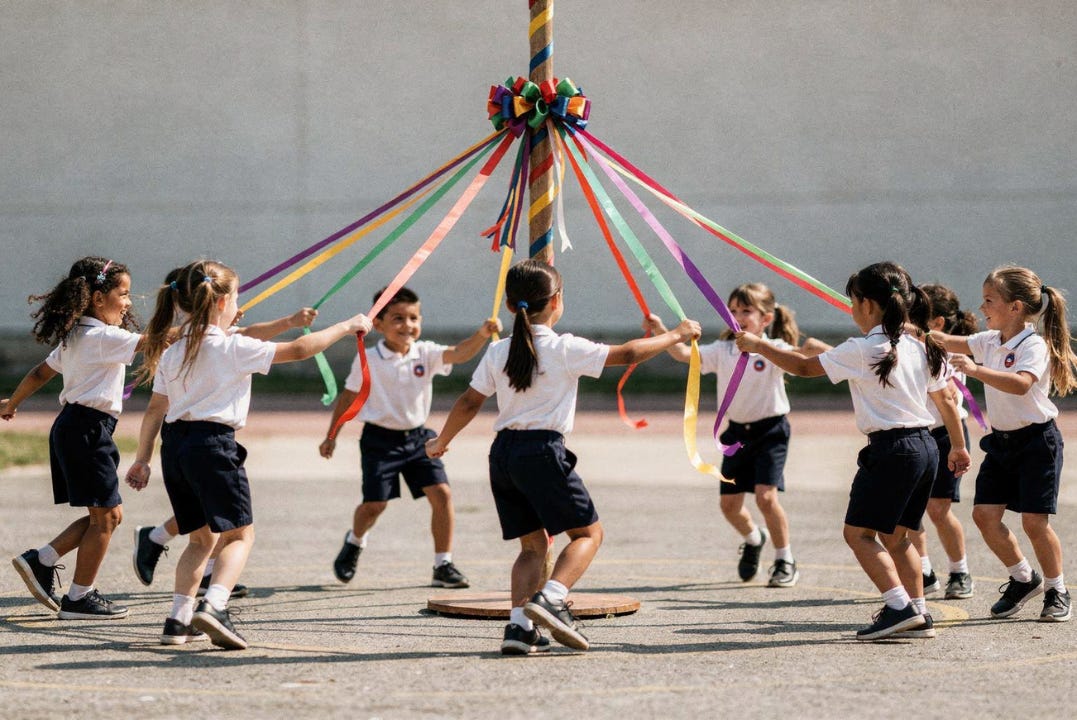
When I was a little girl in Catholic school in the early 1970s, the month of May always felt a little magical. The air had finally warmed, the trees were bright with new leaves, and one afternoon we would gather in the schoolyard to dance around a tall Maypole. Long ribbons—blue, pink, yellow—hung from the top, and as we skipped in circles the ribbons slowly wrapped around the pole in a woven pattern of spring colors. Sometimes we sang songs to the Virgin Mary or attended a special Mass dedicated to her. At the time it simply felt like a joyful celebration of spring.
Why May Became the Month of Mary
In the Catholic tradition, May has long been known as the Month of Mary—the mother of Jesus. Throughout the world, churches mark this season with special devotions: flowers placed before statues, hymns sung in her honor, and the familiar ritual known as May Crowning, where a crown of blossoms is placed upon an image of Mary as a symbol of reverence and gratitude.
For many Catholic children, these traditions became part of the quiet rhythm of springtime faith. Schools and parishes often held special Masses or prayer services dedicated to Mary during the month, inviting the community to reflect on her role in the story of Jesus. The imagery was always gentle and life-affirming—flowers, gardens, new life—symbols that echoed the season itself.
Looking back now, it’s easy to see how naturally the language of spring and the story of Mary became intertwined. May was not only a time of blooming trees and longer days, but also a moment in the church calendar when attention turned toward one of the most enduring female figures in Christian history.
A Broader Spiritual Perspective
Although I grew up in the Catholic tradition, I’m not a practicing Catholic today. My spirituality is deeply rooted in the teachings of Jesus, but over the years my perspective has broadened to appreciate the universal truths that appear across many spiritual and religious traditions. What interests me most now is not defending any particular doctrine, but exploring the stories, symbols, and figures that continue to shape our spiritual imagination. And few figures have generated as much curiosity, reinterpretation, and debate in recent decades as Mary Magdalene.
The Question of Mary Magdalene
As I revisited those childhood May traditions, I found myself wondering about the Mary whose story continues to intrigue historians, theologians, and spiritual seekers alike. The question that keeps returning to me is simple: why does Mary Magdalene continue to capture the spiritual imagination of so many people today?
One detail I didn’t understand as a child—but that becomes important when reading the Gospel stories as an adult—is that several women named Mary appear in the narrative surrounding Jesus. But it was Mary Magdalene who became one of the most intriguing women in Christian history.
Magdalene was not identified by family relationships but by her place of origin—the town of Magdala, near the Sea of Galilee. In the Gospel accounts she appears as a devoted follower of Jesus and is present during some of the most significant moments in the story, including the crucifixion and the discovery of the empty tomb.
For centuries, however, her identity became blurred and misunderstood. Traditions, interpretations, and assumptions layered over the original texts, creating a figure who was often portrayed quite differently from the woman described in the Gospels.
That lingering mystery is part of what makes Mary Magdalene so fascinating today. Over the next few weeks, I want to explore the figure of Mary Magdalene—not as a devotee and not as a skeptic, but simply as a curious student of history, spirituality, and the feminine.
There’s a great deal written about her, a great deal believed about her, and no small amount debated about her. Some of those ideas emerge from the historical record. Others come from biblical interpretation, medieval legend, or modern spiritual symbolism. Each perspective tells a slightly different story about who Mary Magdalene was—and why her presence continues to echo through the centuries.
My intention isn’t to prove anything or defend any particular interpretation. It’s simply to understand why her story has continued to be re-visited.
Perhaps that is part of what makes Mary Magdalene so compelling. Her story sits at the intersection of history, faith, legend, and spiritual imagination. Each generation seems to rediscover her in its own way, asking new questions about who she was and what her story might mean.
For me, this curiosity began unexpectedly while reflecting on those simple May traditions of childhood—the ribbons, the flowers, the quiet reverence for Mary in the springtime.
What I didn’t realize then was that the story of Mary Magdalene would eventually raise questions far beyond those schoolyard celebrations. Questions about history, interpretation, and the evolving ways people understand faith.
I’ll be exploring those questions in the coming weeks—looking at the historical Magdalene, the biblical Magdalene, the legendary Magdalene, and the symbolic Magdalene—to see what each layer might reveal about why her story fascinates people to this day.
If you find yourself, like me, wanting to move from curious student of her story to what it might mean for your own, I’ve created a companion series, The Women Who Knew Series for paid subscribers that explores that shift more personally. Part 1 of the series, Mary Magdalene Was Not Who They Said She Was is available for free subscribers.
Also, if something has been stirring in you this spring — the quiet knowing that this chapter wants to be different — I created something for that.
The Untamed Threshold is a six-month initiation for the woman who is ready to stop managing her disappearance. Eight women only. If you’re interested, applications are now open.