

Mary Magdalene Was Not Who They Said She Was
Part 1 of The Women Who Knew Series — how a familiar story about a “fallen woman” hides a different history of presence and authority.

This May, The Women Who Knew Series, is a five‑part paid series for women in midlife who are never quite given credit for how clearly they see. Part 1 is available to free subscribers.
Through the story of Mary Magdalene — not as a penitent stereotype, but as she appears in the earliest texts, a witness and leader — we trace a much older pattern: how women’s authority is reframed, softened, and translated into something more acceptable.
Each week explores a different facet of that pattern — intuition, suppression, recognition, and the quiet decision to stop waiting to be seen — and closes with reflection questions to help you locate your own place in the story.
You don’t need any particular belief (or belief at all) to enter in, only curiosity about how women’s stories are told and what happens when we start telling our own.
There are certain women in history whose stories feel finished. Cleanly told. Widely agreed upon. Repeated often enough that they begin to feel fixed — like there is nothing left to question.
Mary Magdalene is often presented that way. A woman with a past. A woman who sinned. A woman who was redeemed. It’s a familiar arc — legible, contained, easy to teach without disturbing anything around it. And for most of Western history, that version held. But it wasn’t the original one.
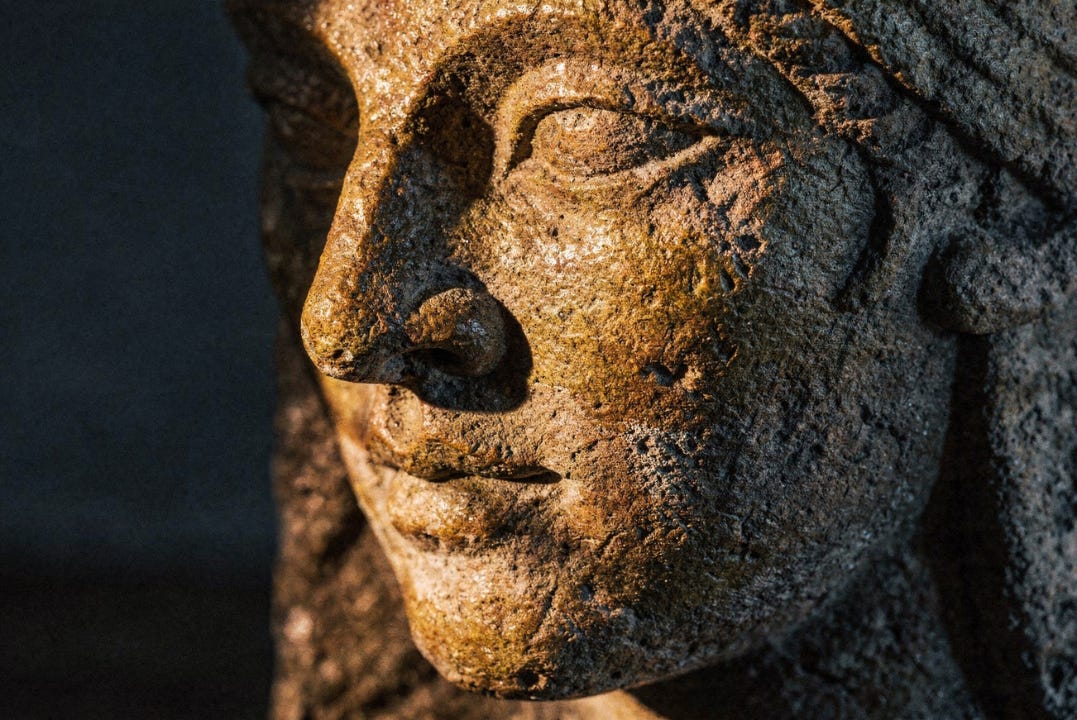
The Familiar but Incomplete Story of Mary Magdalene
Biblical scholar Karen King spent years excavating the earliest surviving texts about Mary Magdalene, and what she found doesn’t match the penitent sinner of medieval tradition. Not all historians agree on how to weigh these texts, but scholars like Karen King argue that they preserve an early memory of Mary as a teacher and apostolic figure, not merely a penitent.
In those early accounts, Mary is not peripheral. She is a disciple — one who understands what others don’t, who speaks with an authority that the other apostles both rely on and, in some texts, openly resent. She is not present at the margins of the story. She is shaping it. The familiar version — the softer one, the more morally instructive one — came later, built deliberately over the earlier one, not through honest disagreement but through a quiet process of substitution.
Some of those early accounts show up in texts like the Gospel of Mary, a second‑century work where she is depicted teaching the other disciples, and in the Gospel of John, where she is the first to encounter the risen Jesus and is sent to tell the others.
Taken together, they preserve a memory of her not as a cautionary tale about sin, but as a witness and a leader at the center of the story.
How Women’s Stories Are Softened and Reframed Over Time
Historian Gerda Lerner documented how this kind of substitution operates across centuries. Women’s roles, she argued, are rarely erased outright. They are reframed — translated into something a given culture can recognize and contain. This is the pattern that repeats: a woman’s direct authority is translated into something more acceptable — piety, sexuality, service, support — while the clarity she carries is kept but quietly downgraded.
Mary Magdalene is one of the clearest examples of this pattern. But she is not unusual in it. What’s striking — what makes her worth returning to — is not only what was changed. It’s what couldn’t be.
She remains at the crucifixion when others are not there. She is the first to witness what comes after. Those details persist across every version of the story, even the ones most determined to make her smaller. Her presence, her proximity to the moment, her willingness to stay when it became difficult — none of that could be entirely edited out. Something in her continued to hold its place even as the narrative around her shifted.
That matters.
Presence That Cannot Be Erased
Because it suggests a distinction worth sitting with: identity can be shaped, softened, reframed. But presence — what a woman actually did, where she actually stood, what she actually witnessed — is harder to erase.
This series is about that distinction.
Not about Mary Magdalene as a religious figure, or a symbol, or a corrective to centuries of misreading. But as a pattern. You don’t have to share a particular faith, or any faith at all, to read her this way; you only have to be curious about how women’s stories are shaped and reshaped over time.
A recurring shape that shows up across history and, if you’re honest, across your own experience too.
She is not the last woman to have been known — but not accurately. Seen — but not entirely. Named — but in someone else’s language.
She is the first in a long line.
Questions to sit with:
Where in your own story do you sense a gap between who you are and the version that gets told about you?
What parts of your “presence” — what you actually did, where you actually stood — feel hardest to erase, no matter how the story has been framed?
This is the beginning of a five-part series. The next parts of this series move into what happens after the noticing—how knowing is shaped, managed, and ultimately reclaimed. The remaining parts of this series are available to paid subscribers.