

The Powerhouses We Inherit
How one family photo and the Mitochondrial “Eve Gene” reveals six generations of feminine power and purpose.

Yesterday my older sister—a youthful grandma in her early 70s—texted a photo of three women, shoulder-to-shoulder. On the left is my sister herself, eyes still twinkling with teenage mischief. On the right stands her daughter, all steady composure and mom-mode confidence. Standing in the middle of them, a gorgeous teenager (who my sister thinks favors me), is her granddaughter—my great-niece—who has perfected the art of looking both cordial and compliant with taking a family photo, and last by not least, her brother, my great-nephew, who coincidentally has the same birthdate as my dad and favors him around the eyes.
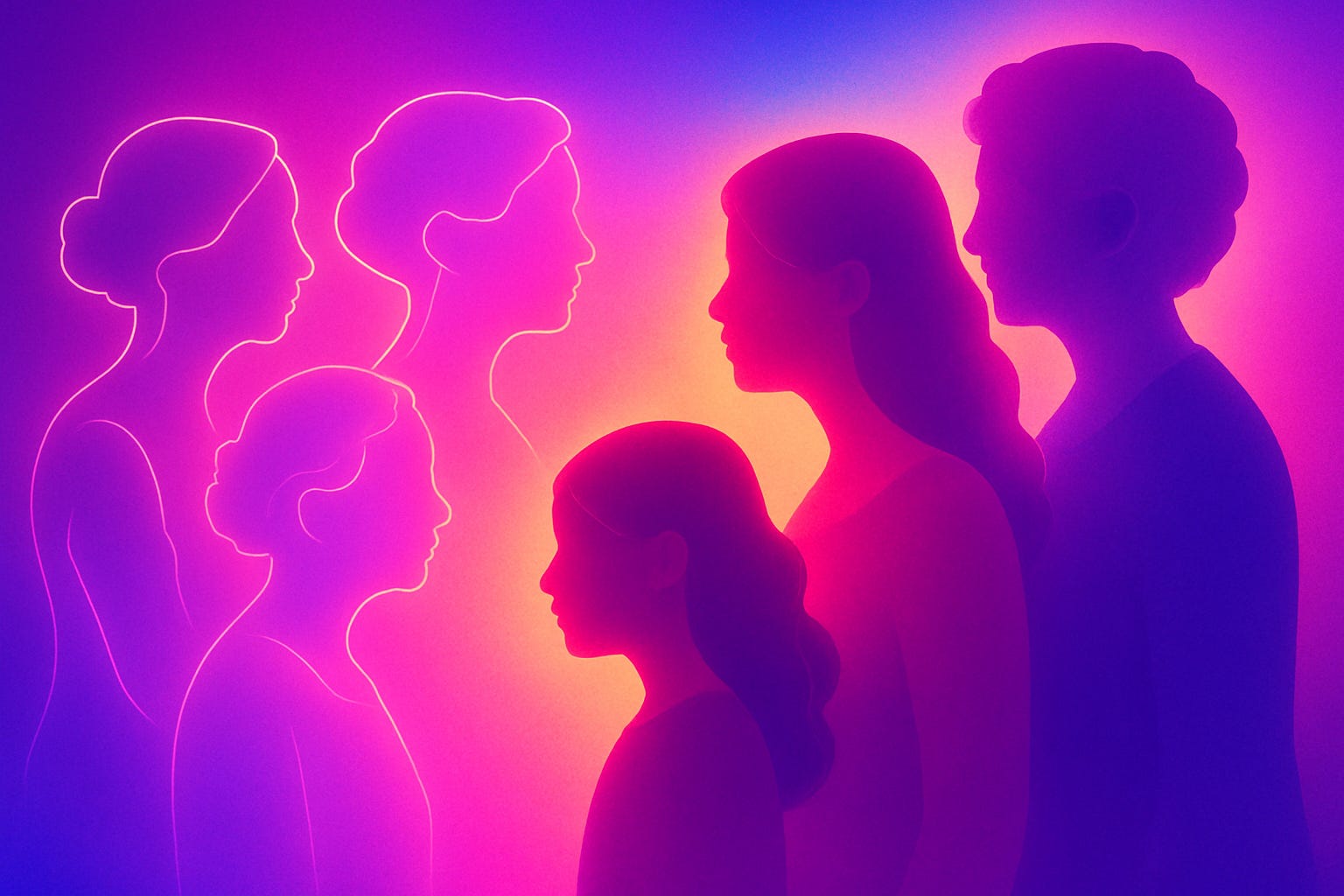
At first I thought, Three generations—how lovely. Then another layer slid into focus. Hovering just outside the frame I sensed three more generations of women: my mother, my grandmother, (and my great-aunt who we called “Nana”, who raised my mother after my grandmother died due to complications giving birth to my mother), and my great-grandmother. They’re gone now, but the line runs straight through my sister to her daughter and on to that stunner of a teen. My great-niece will never sit at their kitchen tables or hear their laughter or singing the way I did; she will meet them only through the stories we tell—and through the mitochondria humming in every one of her cells.
Suddenly the picture’s aperture expanded. I was looking at a six-woman relay team handing off a microscopic torch that has been burning for more than a hundred thousand years.
The Powerhouses—And The Poets—Inside Us
Mitochondria earned their “powerhouse” nickname for churning oxygen and the calories on our plates into ATP, the rocket fuel of life. But they moonlight in dozens of other gigs: sculpting hormones, tempering oxidative sparks, policing immunity, even deciding when a spent cell should bow out with grace. Each organelle carries its own little loop of DNA—just 37 genes—tucked away like a secret family recipe.
Those genes don’t sit passively on a shelf. Estrogen receptors perch on mitochondrial membranes, flipping biochemical switches to keep energy humming and free-radical sparks low. No surprise that when estrogen dips at midlife, many women feel the lights dim—fatigue, brain fog, slower muscle recovery.1 Menopause isn’t just a hormonal plot twist; it’s a mitochondrial moment of truth.
Why Your Mitochondria Come Only From Mom
At fertilization, Dad does contribute a handful of mitochondria along with his DNA, but the egg slaps on a molecular “return to sender” tag and dismantles them within hours.2 Nature seems convinced that one energy system—Mom’s—keeps the power grid stable. As a result, the mitochondrial DNA (mtDNA) in my great-niece is essentially identical to the mtDNA that powered my great-grandmother’s biscuit-baking from scratch talent, the gifts of my grandmother, my great-aunt’s creative expression, and my mother’s gardening green-thumb.
That single thread of maternal inheritance is why a faded black-and-white wedding portrait and a TikTok-savvy teenager can share the same cellular hum.
Enter The “Eve Gene”
Because mtDNA almost never recombines, geneticists can trace its branches like a tree that forks but never interweaves. Follow those maternal twigs far enough and they converge on a single African woman who lived roughly 200 000 years ago—nicknamed Mitochondrial Eve.3 She wasn’t the first woman, nor the only one alive then; she’s simply the most recent common ancestor along purely female lines. In a sense, every daughter is not merely descended from her mother—she is her mother at the level of mitochondrial code.
When Women Held The Map—And The Land
A recent DNA study of Iron-Age burials4 in southern England found many skeletons sharing identical mtDNA while their Y-chromosomes varied wildly. The pattern shouts matrilocality: women stayed put and owned property; men married into their communities. Imagine Celtic grandmothers doling out land deeds while sons-in-law fetched firewood. Looking at my sister, her daughter and granddaughter, I can almost feel that ancient echo—where women held both the mitochondrial keys and the social compass. This matriarchal phenomenon is prominent in my family.
Mitochondria As Memoir
These organelles remember. With stress, toxins, or simply birthdays, they collect tiny scars—mutations called heteroplasmies5—that can dim the cellular lights. But the flip side is just as powerful: the quality of a woman’s mitochondria at conception imprints her child’s baseline vitality. My great-grandmother’s love of singing and humming spirituals and hymns while sitting in her rocking chair in the kitchen, my great-aunt’s penchant for creativity, sewing, knitting, crocheting, and learning to become a milliner, making hats in her retirement years, my mother’s love of gardening, fashion and style, and having a quiet curiosity conveyed by the books around the house I used to play with more than I read as a kid—all of it fine-tuned the voltage my sister, her daughter, and now her granddaughter inherited.
Midlife, Menopause, And Mitochondrial Stewardship
If you’re reading this in perimenopause (I see you), your mitochondria are renegotiating their contract with your hormones. They:
Need R & R – Sleep is when mitochondrial DNA repairs itself.
Crave micronutrients – Magnesium, B-vitamins, CoQ10, and polyphenols help electrons glide smoothly.
Love movement, not mayhem – Interval walks and strength training spur new mitochondria without the cortisol spike of chronic cardio.
Hate loneliness – Laughter with friends lowers oxidative stress; yes, brunch is cellular medicine.
Treat this not as a chore list but as love letters to the foremothers who entrusted you with their power plants.
A Guided Reflection for Your Journal
Study a family photo. Notice the hands, the posture, the glint in someone’s eye—then imagine the identical mtDNA powering each gesture.
Name the gifts. What traits—energy, resilience, creativity—seem to ripple down your maternal line?
Name the wounds. Which patterns (exhaustion, self-neglect) might also be echoing?
Write a vow to your mitochondria. Such as, “I will rest, lift heavy things, and keep singing so the next girl in line inherits batteries fully charged.”
An Invitation
Hold a photograph of your maternal line up to the morning light—yes, even if the youngest face is half-hidden behind a phone case plastered with anime stickers. Feel the continuous low humming sound in your own chest: that’s nano-power plants, millions per cell, still churning out life exactly as they did for the women whose names your great-niece will only learn in family lore.
We are not merely descendants; we are continuations. Every choice we make—each bite of food, each boundary we defend, each deep belly laugh—tunes the voltage we pass forward.
Here’s to stewarding the “Eve gene” with the reverence it deserves. May our daughters’ daughters—teenagers, rebels, dreamers—feel the charge.
Jim Schnabel, Scans show brain's estrogen activity changes during menopause, Weill Cornell Medicine, June 21, 2024
Lisa Marshall, Why We Only Inherit Mitochondria from Moms, Neuroscience News, October 9, 2024
Mitochondrial Eve, Wikipedia
Nicola Davis,Iron age men left home to join wives’ families, DNA study suggests, The Guardian, January 15, 2025
Kuiper L. et al., Deleterious Mitochondrial Heteroplasmies Exhibit Increased Longitudinal Change in Variant Allele Fraction, iScience, Volume 28, Issue 6, 2025