

Pleasure in Midlife: When You’re Too Tired to Want Anything
Micro‑pleasure, nervous system capacity, and the quiet return of feeling.

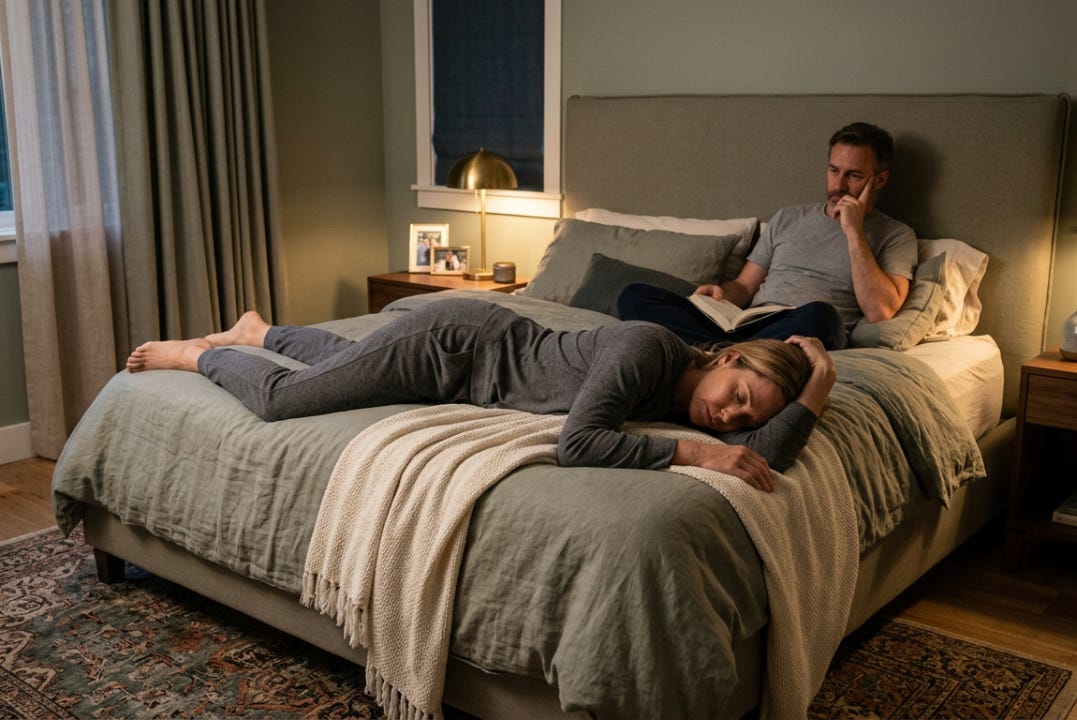
There’s a particular kind of midlife exhaustion that isn’t just about sleep. You can go to bed early, take your supplements, even take a weekend away—and still wake up feeling like life is something you’re getting through, not something you’re actually in. On paper, you might say you want more pleasure: more joy, more intimacy, more aliveness. But when you look at your actual days, what you mostly feel is numb, overstimulated, or just too tired to want anything at all.
If that’s familiar, I want to start with this: your difficulty accessing pleasure is not a character flaw. It’s information. It’s your nervous system telling the truth about what it’s been carrying—and what it can’t fake anymore.
Pleasure is bigger than sex
When many women hear the word “pleasure,” their minds go straight to sex. They think about libido, their partner (or the absence of one), how often they are or aren’t having sex, how responsive they “should” be, and how much they wish they wanted more. That alone can be enough to shut the conversation down.
So let’s widen the frame. When I talk about pleasure in midlife, I’m talking first about your capacity to feel good in your own body—in small, ordinary, non-sexual ways. Pleasure is the exhale you feel when you sit down and your shoulders finally drop. It’s the way warm water feels on your skin in the shower when you’re actually there, not already in your inbox. It’s the taste of something you enjoy when you’re not gulping it down between tasks. It’s the moment you catch sunlight on a wall and let yourself enjoy it for three seconds longer than usual.
Sexual pleasure lives inside that broader field. If you are deeply disconnected from non-sexual pleasure, it’s very hard for your body to suddenly switch on and feel open, curious, and receptive sexually on demand. This isn’t because you’re broken. It’s because your system is organized around survival, not enjoyment.
How subtle disconnection from pleasure looks
She might be the same woman who has already noticed her identity shifting, or who has started questioning what confidence actually means.
The case study for this month is not the woman who hates her life and wants to burn it all down. It’s the woman who is “fine.” She has a lot to be grateful for. She can name things she enjoys in theory. She remembers moments of deep joy, deep connection, deep desire. And yet, day to day, pleasure has quietly moved to the margins.
It looks like having a favorite mug but only noticing it when it breaks. Sitting in a beautiful room and realizing you haven’t really seen it in weeks. Eating on the go so often that you can’t remember the last time you tasted your food all the way through. Interacting with people you love mostly through logistics and problem-solving, not actual connection. It’s not dramatic. It’s “just life.”
Underneath that phrase—“this is just life”—what your body often means is: I have not had enough room to feel pleasure in so long that I’ve stopped even looking for it. That is disconnection. Not because you’re defective or ungrateful, but because your nervous system has quietly adapted to the load it’s been under.
Micro-pleasure: starting where you actually are
When you’ve been living in survival mode, the idea of “reclaiming pleasure” can feel like one more thing to do. You do not need a new hobby, a weekend away, or an expensive ritual to begin. You need micro-pleasure: tiny, accessible moments of genuine enjoyment that your system can actually register.
Micro-pleasure is taking one conscious breath with your hand on your chest before opening your laptop. It’s letting yourself savor the first sip of coffee or tea without picking up your phone. It’s standing in the sun for 30 seconds and letting your skin feel warm. It’s putting on lotion with a little more presence than usual, or listening to one song all the way through without multitasking.
These are not glamorous. They won’t earn you any points. No one will applaud you for them—and that’s the point. Micro-pleasure is for your nervous system, not your résumé. It’s how you begin to let pleasure exist in a life that is already full, instead of waiting for some hypothetical “someday” when everything slows down.
Nervous system capacity: why it can feel unsafe to feel good
Here’s the part that often gets missed: even when your mind wants more pleasure, your body may not feel safe enough to relax into it. If you’ve spent years in a state of chronic stress, constant responsibility, emotional over-functioning, or hypervigilance about other people’s needs, your nervous system has built a high tolerance for intensity and depletion—and a very low tolerance for genuine rest and enjoyment.
Pleasure asks you to slow down, receive, let your guard down, and release a bit of control. If your lived experience has taught your body that “good things” are followed by crashes, criticism, or disappointment, then pleasure doesn’t feel neutral. It feels risky. So your system does something very intelligent: it turns the volume down.
Instead of big spikes of feeling, you get muted, manageable gray. Not joy, not despair. Just flat. This is not because you are incapable of pleasure. It’s because your nervous system has been doing exactly what it needed to do to get you through. The work now is to widen your capacity slowly, not to rip the dial from zero to ten overnight.
Pleasure as practice, not reward
Many women have been taught, explicitly or implicitly, that pleasure is something you earn. You get to rest when the list is done. You get to enjoy something after you’ve “deserved” it. You get to feel good once you’ve taken care of everyone else. The problem is that the list is never done. Pleasure becomes a distant horizon that you move toward but never reach.
What if pleasure was not a reward for good behavior, but a practice for being a human with a body? A practice that nourishes your nervous system so you can keep doing the life you’re doing. A practice that reminds you that you exist outside of your utility. A practice that reconnects you to desire in small, manageable doses so that bigger desire doesn’t feel so dangerous.
Practice implies that you’re not expected to get it right. You will forget. You will fall back into old patterns. You will go days where you remember this and then weeks where you don’t. That doesn’t mean you’ve failed. It means you’re human.
This is the same current that runs underneath my Siren work: pleasure and desire as practices of coming home to your body, not performances you have to earn.
A few questions for your week
As you move through this week, you might experiment with these questions.
Where have you quietly decided that pleasure is not available to you right now?
What is one micro-pleasure you can offer your body today that doesn’t require more time, money, or effort—just a tiny bit more presence?
When you do allow a small moment of pleasure, what happens in your body?
Do you tense?
Do you rush past it?
Can you stay for one breath longer?
You don’t need to overhaul your life to begin reconnecting to pleasure. You can start by noticing the places where it already exists in your day and giving those moments just a little more of your attention.
If this is where you are right now
If you’re feeling disconnected from pleasure in subtle ways—not in a crisis, not in a dramatic collapse, but in the quiet “just getting through” of your days—you’re not alone. You’re also not broken. Your desire is not gone; it may be protected. Your pleasure is not absent; it may be unregistered. Your capacity is not fixed; it can expand as your nervous system feels safer and more supported.
This month, we’re not asking you to become a different woman. We’re simply asking: what would it look like, in this actual life, in this actual season, to feel even a little bit more?
This is the third layer of June: not a perfect pleasure practice, but the quiet return of feeling in a body that has carried a lot.
If this writing is landing for you and you want to go deeper in your body — not your head — The Siren Signal is a short, intimate 7-track audio experience for midlife women reclaiming magnetism, desire, and embodied truth. $55. No fixing required.