

On Life‑Earned Spiritual Authority and the High Priestess
How a lifetime of quiet initiations—Catholicism, corporate hierarchies, and mysticism—finally named the archetypal threshold I’ve been holding in my own life—and now seeing in other women.

Before we shift into June’s focus on pleasure, confidence, and erotic identity, I want to name the archetypal threshold I find myself standing in these days—and the life‑initiated path that led me here. If you’ve been with me through the Mary Magdalene series, this may feel less like a plot twist and more like a reveal.
I was the kid who went to Mass before school because I wanted to, not because anyone made me.
While my classmates ran around on the playground, waiting for the bell, I’d slip into the dim quiet of our parish church and sit there alone, watching the priest move through the ritual of the Mass. I hadn’t even made my First Communion yet. I didn’t know the theology. I didn’t have language for transubstantiation or liturgy or sacrament. I just knew something was happening on that altar that felt more real than whatever was going on outside.
I remember staring at the chalice, the bread, the candlelight, the slow choreography of sit–stand–kneel, trying to make sense of why this moved me so much. Other kids saw boredom; I felt a pull. It wasn’t about being a “good Catholic girl.” It was curiosity mixed with a kind of reverence, as if my body understood the mystery long before my mind could catch up.
I didn’t have the word for it then, but looking back, that was my mystic in formation.
One morning, sitting there in my school uniform, I decided I was ready.
I knew the rule: you wait until second grade, until the white dress and the veil and the photos and the formal ceremony. But I also knew, in that quiet, that I understood what was happening well enough to say, yes. So when it was time for Communion, I got in line with everyone else. When the Priest declared, “body of Christ” and the wafer was placed on my tongue, I said “Amen,” fully aware of what that Amen meant to me. The priest must have assumed I was at least in the second grade. That was my real First Communion. I didn’t dare tell anyone. The official First Communion came later—with the white dress, the ritual, the family pictures—but God and I both knew I’d already crossed that threshold.
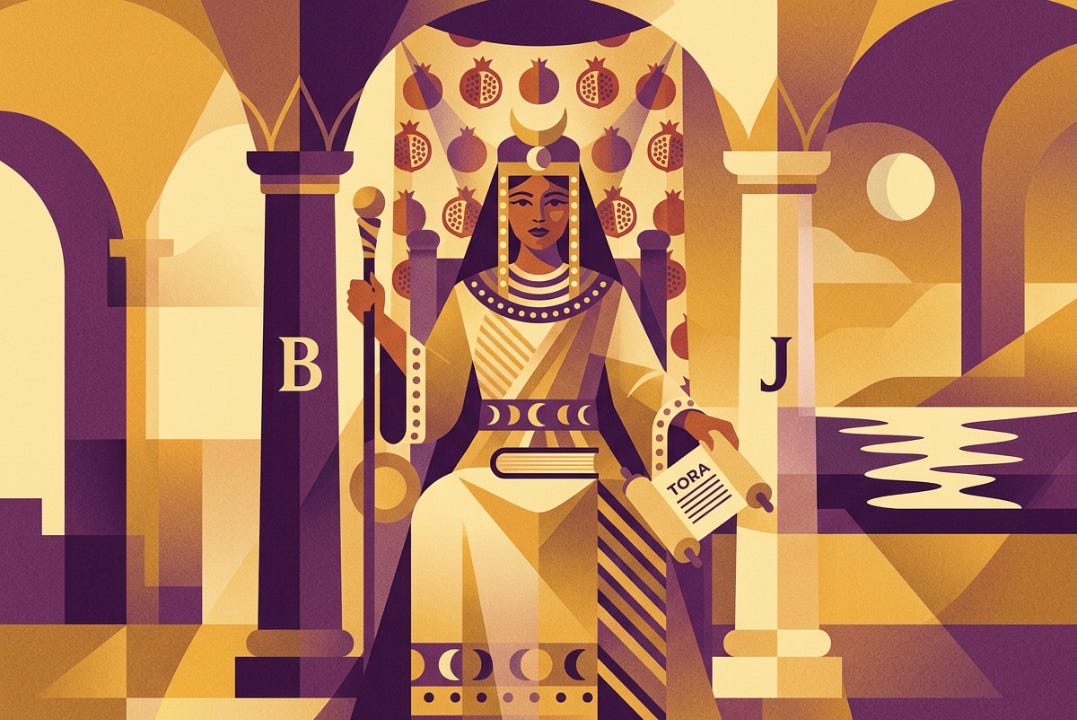
Although I grew up in the Catholic tradition, I’m not a practicing Catholic today. My spirituality is still deeply rooted in the teachings of Jesus, but over time it’s widened beyond the need for religious guardrails. These days, I’m less interested in defending doctrine and more interested in the stories, symbols, and figures that keep shaping our spiritual imagination—whether they come from scripture, sacred text, ancient wisdom, tarot, myth, or a deck called The Priestess Oracle created by Sophie Sun.
The High Priestess as Threshold
Decades later, when I first encountered the High Priestess card in tarot, there was an immediate, almost electric recognition. It wasn’t, “Oh, I want to be that.” It was, “Oh. That explains a lot.”
In most descriptions, the High Priestess sits at the threshold between worlds—between the conscious and the subconscious, the seen and the unseen, matter and mystery. She’s the one who listens beneath the noise, reads the patterns others miss, and translates what lives behind the veil into language people can actually use. She doesn’t perform the mystery; she tends it.
Over time, I realized that what I resonate with isn’t “High Priestess” as a title or position—no one has initiated me into a formal order, and I’m not looking for that. What resonates is the High Priestess as an archetypal threshold: a way of naming a life that has slowly, stubbornly, initiated me into standing exactly there. Between worlds. Between systems. Between old identities and new ones.
For me, the High Priestess isn’t an aspirational aesthetic or a spiritual brand. She’s a container that finally fits the way my life has unfolded—a frame big enough to hold the mystic child in the pew, the woman pulling priestess oracle spreads before a launch, the femtech customer engagement strategist reading patterns in broken platforms, and everything in between.
Life‑Initiated vs. Lineage‑Initiated Priestess
I’ve always trusted inner readiness more than external timing. As a child, that looked like quietly taking Communion when I knew what it meant to me, long before the church said it was “time.” As an adult, it has looked like crossing thresholds when the yes in my body arrived—sometimes years before the outer world had language or structure for what I was stepping into.
So when I talk about the High Priestess, I’m not talking about a title someone bestows, or a role you get initiated into by a formal order. I’m talking about a way life initiates you, slowly and often without fanfare, over decades.
There are women who are priestessed into lineages with ceremony, vows, and visible markers of their role. That path is real and powerful. It’s just not mine. My initiations looked like mystical experiences no one around me had words for. Fifteen years inside enterprise tech, reading emotional and systemic patterns while my job description said “Customer Success.” Six years inside digital health platforms, feeling in my body where the system failed women even when the metrics looked fine. Training in functional medicine and somatic sex coaching because I could feel that the body was holding far more truth than the intake forms ever captured.
None of that came with a priestess certificate. But it did something to me.
Over time, it trained me to stand in very particular thresholds: between patients and platforms, between women and their own bodies, between what a company thinks it’s doing and what women actually experience on the other side. It trained me to listen for what isn’t being said. To trust the information in my nervous system. To hold paradox without rushing to solve it.
If there is such a thing as life‑initiated priestess‑ness, that’s how it came for me: not in a weekend on a mountaintop, but in a thousand small crossings over sixty years.
And just to be clear, I’m not a tarot reader or a professional oracle interpreter. I’m a woman who’s learned to seek wisdom from multiple sources at once—biology, physiology, psychology, sacred text, lived experience, and yes, sometimes a deck of cards. The oracles are one lens among many, not the only one.
If you’re newer to my world, this is the same spirit behind what I call The Woo Report, a section of my weekly newsletter from Being Well Aware, my coaching practice (separate from Substack). The Woo Report is simply one of the lenses I use—alongside everything I know to be true about bodies, systems, midlife, and human behavior. Take what resonates. Leave the rest.
The Oracle Spread that Outed Me
Which brings me to the afternoon a deck called The Priestess Oracle basically outed me to myself. It freed my High Priestess nature.
The day before the official launch of The Siren Signal a few months ago, I felt nudged to pull a few cards. Nothing elaborate—just a check‑in. I picked up this deck I’d only touched once before, shuffled, and pulled five cards. Only afterward did I realize that in this particular deck, five cards form a spread called “The Priestess Pillars.”
The positions were:
Soul Purpose
Current Initiation
Sacred Support
Divine Action
Legacy Light
I hadn’t planned that. I didn’t even know it was a thing.
When I placed the cards in their spread positions, I then opened the guidebook, it felt less like a reading and more like someone handing me an architectural drawing of my current life.
(1) In the Soul Purpose position, I pulled Hekawet, a card about highest magic, highest light, highest power—language that mapped directly to what The Siren Signal actually is for me: not content, but a transmission—I was launching it the next day.
(2) In Current Initiation, I AM, a card about sacred purity and Christ light, which is exactly what this season has been—refining my voice, stripping away what’s performative, and trusting the pure impulse over the “shoulds.”
(3) In Sacred Support, the Isis Chamber, representing transformation, upgrade, golden empowerment—the energy of The Untamed Threshold, an offer I birthed shortly after this spread, and the energy of other containers I’ve been building for women.
(4) Divine Action was Ishtar, landing as galactic mother, cosmic balance, quantum birth—the energy, and action, of that launch itself.
And (5) Legacy Light, an Etheric Light Temple, spoke in terms of divine invitation, sacred assignment, greater impact—reflecting the long‑arc work my life keeps pulling me toward.
I should say this outright: I never pull cards to ask, “What should I do?” By the time I sit down with a deck, I’m already in motion. The spreads don’t make my decisions for me. They confirm movement I’m already in, ground what I’m sensing, and give language and context to the current flowing through my life.
So I didn’t experience that spread as fortune‑telling. I experienced it as recognition. It was as if the deck said, “Here is what you’re already living, laid out in priestess language. Here is the threshold you’ve been standing in for a long time.” Not a role I was trying to step into from the outside, but an archetype catching up to what my life had already made me.
The Blueprint Laid Out in Nine Acts
Some weeks later, I pulled from the same deck again and landed in a spread called The Temple of Ma’at—a nine‑card layout that tracks from root to blessing. I didn’t go into it lightly. By then I knew this deck carried a certain voltage, and I anchored myself before I shuffled. Still, I wasn’t prepared for how precise it would be.
The positions moved from Foundation and Shadow through Sacred Power, Heart, Ancestral Wisdom, Alignment, Higher Path, and finally Divine Blessing. Card after card came out in clusters, as if they had something urgent to say. When I placed them in their spread position I then sat with the guidebook, it felt like a fuller, more zoomed‑out version of the same message: “Here is what you’re already building”, in priestess language.
(1) The Foundation was pure joy, pranic life force, highest light—an insistence that my work is rooted not in fixing or striving, but in vitality and the aliveness of being in this particular body, at this particular age.
(2) The Shadow was transition and safe passage: the threshold itself, the death‑rebirth of identities and systems, not as a problem to solve but as the actual work.
(3) The Light was divine beauty and presence power—the way I’ve always been drawn to making the mystical felt, not abstract.
(4) Sacred Power came through as dragons and fierce, protecting wisdom.
(5) The Heart spoke of being a “new world architect,” more interested in building different structures than in optimizing broken ones.
(6) Ancestral Wisdom repeated the High Council of Light card that had stopped me in my tracks months earlier, the very first time I picked up this deck and pulled 1 card, the High Council of Light card—this time it was in the position of being in collaborative leadership with something much older and wiser than my individual biography.
(7) Alignment came as Merkaba, interdimensional travel, translation between worlds.
(8) Higher Path showed up as stellar memory and divine legacy—the sense that my next step is less about acquiring more, and more about remembering what I already know.
(9) Divine Blessing, once again, was the Isis Chamber: transformation, upgrade, golden empowerment—the exact energy of The Untamed Threshold and the containers I’m holding now.
Like every other time I’ve pulled from this deck, it wasn’t giving me a to‑do list. It was mirroring back the architecture of work that was already underway.
It was, in every direction I looked, a blueprint. Not just for Being Well Aware or The Untamed Threshold, but for my other company, Metis Femtech as well. Individual transformation work and systemic transformation work, both laid out in the same Temple. Two expressions of one assignment.
I anticipated the power of the spread so I was anchored and ready for the depth I knew it would reveal. But still. Wow.
I’m no Egyptologist, nor am I particularly fluent in Hermetic traditions. I know this is full tilt woo—I see it too—but sometimes the woo is exactly what makes you go, “okay, wow.”
Woo can just make sense.
A Container Big Enough for My Multitudes
At that point, it became harder to pretend this was random. Like Whitman, I came to the conclusion long ago that I contain multitudes. I just do. The mystic who sat in the church alone as a child. The debutante on the fringe of the black elite. The enterprise tech customer success professional who led by example in corporate spaces. The functional medicine coach who could connect biological, and systematic dots to what my clients were experiencing in life. The somatic sex coach who knows the body can speak volumes about what’s actually true. The femtech customer engagement strategist with a particularly unique vantage point of being a coach practitioner in the field and a specialist in recurring revenue retention. The founder of Metis Femtech. The architect of The Untamed Threshold. And the woman who pulls priestess oracle spreads the day before a launch. Multitudes.
For a long time, I treated these as separate rooms. There was the professional room, where I talked about brain fog and behavior change, recurring revenue and retention metrics. And there was the private room, where I sat with oracles and mystical experiences and the quiet ways I’ve always been led by my intuition and inner knowing. I kept them apart partly to be legible, and partly because I didn’t have a container big enough to hold all of it in public.
The High Priestess archetype gave me that container. Not as a crown I wear, not as a title I introduce myself with, but as a frame that can hold all of these expressions without requiring me to flatten myself.
If the High Priestess is the part of me that stands at the threshold, reading patterns and listening beneath the surface, there’s also a part of me that’s deeply interested in what happens on the other side of that threshold—building and tending real ecosystems where women can actually land and grow. Being Well Aware, The Untamed Threshold, and Metis Femtech are all versions of that.
Earned Authority, Not Borrowed
I need to say something about authority. We live in a culture that loves borrowed authority: certificates, titles, initiations, ordinations, blue check marks. I have some of those. I’ve earned health coaching certifications. I’ve trained in functional medicine coaching. I’ve been a somatic sex coach. I’ve managed strategic, multi-million dollar accounts in enterprise tech and contributed to building digital health companies. Those credentials matter. They gave me skills and language.
But they’re not the source of whatever priestess‑ness my life carries.
The authority I’m talking about here is quieter and older. It’s the kind that accrues when you live something for a very long time, metabolize it in your body, and keep showing up to it until it reshapes you. It comes from mystical experiences you had no measurable grid for at 20, at 40. From watching systems fail people and refusing to look away. From holding women through thresholds in their health, sexuality, and identity until you can feel the pattern of how transformation moves. From spending sixty years in conversation with the mystery, sometimes willingly, sometimes dragged.
That’s earned authority.
No one can confer it on you, and no one can take it away. At some point, you either recognize it in yourself or you don’t.
For me, the High Priestess language is simply a way of acknowledging what my life has already made me. Not to elevate myself above anyone else, but to stop pretending I’m “just” a coach, or “just” a consultant, or “just” a woman who likes oracle decks on the side. The work I do sits at a threshold. So do I.
For The Women Who Feel This Too
If any of this is resonating in your body as you read it, this part is for you.
Maybe you were the child who felt something real in church or synagogue or temple, long before you had words for it. Maybe you’ve always been the one in your family or workplace who “just knows” when something is off, or when a season is ending, or when it’s time to move—even if you can’t prove it on paper.
Maybe you’ve spent years holding other people through their thresholds: births and deaths, illnesses and divorces, career changes and spiritual disillusionment. You’re the one people call when their old life is falling apart and they need someone who can sit in the rubble without flinching. You might have a stack of training behind you, or you might have none. But your body knows what it’s doing when the threshold opens.
Maybe you’ve had mystical experiences you’ve never fully told anyone about because you didn’t have a context for them. Maybe you’ve studied, practiced, prayed, pulled cards, journaled, listened, watched, and quietly walked yourself through initiation after initiation. And yet you still hesitate to claim what you carry because no one has ever officially dubbed you anything.
If so, you’re who I’m thinking of when I say “a life‑initiated priestess.”
The High Priestess as Threshold, Not Title
I’m not interested in policing who gets to use that language. There will always be people who believe spiritual authority must be conferred externally—that without a lineage, a ceremony, a title, you’re playing dress‑up. And for some paths and traditions, formal initiation is both necessary and right. I’m not arguing with that. I, too, could claim lineages. But it's not necessary when life initiates you.
What I am saying here, is that there’s another way this can look.
For some of us, the High Priestess isn’t a title you earn. She’s a threshold you eventually realize you’ve already crossed. Not because someone said you could, but because years of lived experience, inner work, and quiet service have made it impossible to deny what you are actually doing.
So I’m not here to announce, “I am a High Priestess.” I’m here to name the pattern I see in my own life, and to offer a container, an archetype, for women who recognize the same pattern in theirs.
Women who have been priestessing for decades without calling it that. Women whose authority is earned, not borrowed. Women who have been sitting at thresholds—between worlds, between systems, between old and new lives—long enough to know that this is simply how they are built.
If you feel the pull of the High Priestess archetype, you don’t need my permission to explore it. You don’t need anyone’s.
But if something in your chest just exhaled reading this, consider the possibility that you’re not “trying on” an identity. You might just be finally naming the threshold your life has already walked you across.