

Not Everyone Blooms At Sunrise
Honoring My Nocturnal Rhythm, Redefining Rest, and Reclaiming Creativity

I don’t bloom at sunrise. My mind opens in the hush after midnight, when the inbox sleeps and the world stops tugging at my sleeve. Ideas sidle closer then—unrushed, unperformed, a little feral. For years I tried to wrestle myself into morning, to fit the cultural script that says discipline looks like a 5 a.m. alarm and a green juice glow. But my body kept telling the truth: I’m most alive in the dark. This piece is my permission slip (and maybe yours) to honor a nocturnal rhythm, to redefine what “rest” means off the 9-to-5 clock, and to reclaim creativity without apologizing for when it arrives.
And yes, I’ll touch the science too: sleep timing varies from person to person, and chronotypes are real. The point isn’t to glamorize insomnia—it’s to design rest, work, and recovery around the rhythm you actually have, so your nights restore you and your days stop feeling like a fight.
For years I treated a 10:00 p.m. bedtime like a moral achievement—evidence that I was disciplined, “wellness-aligned,” doing it right. Most sleep guides agree (including the one I give clients): lights out by 10, screens off by 8, no late meals. The science is solid. But about five years into post-menopause, my nights started humming. After dark I felt more awake—creatively, intuitively, spiritually—than I ever did at dawn. So I stopped wrestling myself into morning and started honoring what was already true. Sleep researchers call this a chronotype—the biological timing pattern that makes some of us larks and some of us unapologetic night owls.
If that’s you too—if your best ideas slip in at midnight—maybe nothing’s wrong. Maybe you’re simply in rhythm with a deeper current, something ancestral and intuitive, with a touch of magic.
A Night Owl With a Purpose
I’ve always had a night-owl streak, but it intensified post-menopause. My mother was the same way. I remember hearing her pad around the kitchen at night, warming milk to “fix her insomnia,” then napping the next day. I didn’t realize how much I mirrored that until recently. And the astrology checks out for me: Cancer Sun, ruled by the Moon. I was born after 1:00 a.m., and it feels less like a quirk and more like a blueprint. I joke that I came into this world under the stars and I’ve been whispering with the night ever since.
Energetically, I think there’s more at play. I may be tapping a moonlit frequency encoded in my lineage. My mother’s rhythm lives in my nervous system. The hour of my birth shaped how and when clarity arrives. The older I get, the more these nocturnal whispers feel like divine timing—not random sparks.
What the Science Says
I respect the science, truly. Earlier sleep and consistent wake times are associated with better metabolic health, mood regulation, and hormone balance. Melatonin, growth hormone, and the circadian system all have timing patterns, and stability usually helps—especially in midlife when everything can feel wobbly.
And yet—my body doesn’t read those memos. When I try to follow the “ideal” plan, some nights I lie awake for hours while ideas unfurl and my most productive window opens. It doesn’t feel like insomnia; it feels like inspiration. Giving myself permission to honor that changed my relationship with rest. The nuance: chronotype is real, menopause can shift sleep architecture and timing, and “best” looks different when you build consistent, supportive routines around the hours that actually restore you.
Science Sidebar: Night Owls, Menopause, and Real Rest
Chronotypes are real. Your internal timing (lark → owl) is partly genetic and shaped by light exposure and age. It’s normal for some people to think, feel, and create best later in the day.
Circadian rhythm ≠ sleep pressure. Your 24-hour clock (circadian) sets when you feel alert; sleep pressure (homeostatic drive) builds the longer you’re awake. If your circadian “peaks” at night, forcing an early bedtime can backfire because sleep pressure isn’t high enough yet.
Menopause changes sleep architecture. Shifts in estrogen and progesterone can fragment sleep, raise nighttime awakenings (hot flashes/night sweats), and alter REM/NREM balance. That doesn’t mean you can’t sleep well—just that timing and routines may need adjusting.
Consistency still helps—on your clock. Regular anchors (light in your morning, wind-down cues at night, movement, steady meals) stabilize hormones and mood. Align the anchors to your natural window rather than fighting it.
Naps can be strategic. Short, early-day naps can restore alertness without overly denting nighttime sleep; longer “recovery” naps may be useful after short nights but work best if not too late in the day.
Hormones & helpers. Progesterone has GABA-ergic (calming) effects; estrogen influences temperature regulation and sleep continuity. Supplements like magnesium or GABA may support relaxation for some people—individual responses vary. (Medical guidance is wise.)
Try This: Gentle Experiments (Find Your Rhythm)
For Night Owls
Light flip: Get 5–15 minutes of outdoor light within an hour of waking; dim household lights 90 minutes before your natural bedtime.
Anchor windows: Keep a consistent sleep window (e.g., 1:00–8:30 a.m.) for 10–14 days and re-assess energy/mood.
Nap smart: Try a 15–25 min “spark” nap before 3:00 p.m. If you had a short night, allow a 60–90 min recovery nap before 2:00 p.m.
Evening screen hygiene: Use “night mode” and lower brightness after 9:00 p.m.; swap doomscrolling for a single-focus task (journaling, outlining, voice notes).
Wind-down cues: Same three cues nightly (e.g., magnesium tea → warm shower → 5 mins breathwork).
For Larks (or when you want an earlier phase)
Morning light blast: 20–30 minutes of bright outdoor light within 30 minutes of waking; keep lights bright indoors until mid-morning.
Caffeine cut-off: No caffeine after 12:00 p.m. for one week—note sleep latency and depth.
Evening buffer: Stop vigorous exercise and heavy meals 3 hours before target bedtime; keep lights low after sunset.
Micro-shift: Move bedtime/wake-time earlier by 15 minutes every 2–3 nights until you land where you feel best.
Universal Anchors (works for any chronotype)
Same wake time ±30 mins (even after a weird night).
Move daily: 20–40 minutes of gentle-to-moderate movement sometime before 3:00 p.m.
Steady meals: Aim for consistent meal times; add protein at breakfast to stabilize energy.
Mind the mind: 5–10 minutes of breathwork or yoga nidra when you can’t sleep—no pressure to “perform sleep.”
How My Rhythm Actually Works
These days, I rarely see coaching clients before noon. Sessions usually start between 12:00 and 3:00 p.m., and I may go until 6:00 or 7:00 p.m. Mornings are slow and dreamy—still connected to what surfaced overnight. I wake gently, journal dreams, sip matcha with cinnamon, and ease into the day. By afternoon, I’m ready to connect and serve.
My creative tide crests around 9:00 p.m. Between then and about 1:00 a.m., I write, plan, and do the soul-depth work. It isn’t just productivity—it’s alignment. It’s sacred. Because I work for myself, I can lean into this fully.
I also nap—sometimes once, sometimes twice. These aren’t just rests; they’re dreamspace. I often wake with images and phrases that feel like guidance. From a science lens, daytime napping can help with a delayed circadian phase and sleep pressure; from a soul lens, it’s revelation. Practically, I treat it as part of a gentle, polyphasic rhythm that supports both body and intuition.
And I don’t do this without support. I’m on BHRT—bio-identical estrogen, progesterone, and testosterone—because hormones influence sleep quality and circadian regulation. I also use GABA and magnesium to support nervous system calm and deeper sleep. This isn’t about burning the candle at both ends; it’s about giving my body what it needs to recover, regardless of the clock.
There are nights when I follow a more traditional pattern—lights out around 10:00 p.m., a deliberate wind-down, easy sleep. I welcome that too. But when the download arrives at 10 or 11, I don’t resist. I heed the call. That, too, is rest: resting in alignment with my own rhythm.
The 11:00 p.m. Sweet Spot
As I write this, it’s 11:00 p.m.—and I’m in the zone. This hour is special. The house is quiet. The world has settled. It isn’t just the absence of noise; it’s the presence of space. Thoughts land cleanly. Connections click—in my mind, body, emotions, and intuition. My nervous system isn’t pulled in five directions; it’s at ease. That’s when truth rises.
At 11:00 p.m., the veil between insight and awareness thins. Journaling, channeling, weaving something meaningful into form feels natural. It’s not hustle—it’s harvest. Neuroscience would say the inner critic quiets at night and alpha/theta waves rise. I’d add: this is when the moon whispers, when spirit speaks, when the deeper parts of us can finally be heard.
What This Means for Other Women
If you come alive after sunset, hear this: you’re not out of sync. You may be synced to something more ancient, more intuitive, more yours. In midlife and menopause—when hormones shift and old patterns stop fitting—charting your own rhythm can be profoundly healing.
Moon-influenced living isn’t for everyone, but for some of us it’s freedom, power, a return to self. This isn’t about rejecting science; it’s applying it with nuance. Notice your body at 10:00 p.m. Are you ready for bed, or ready to create?
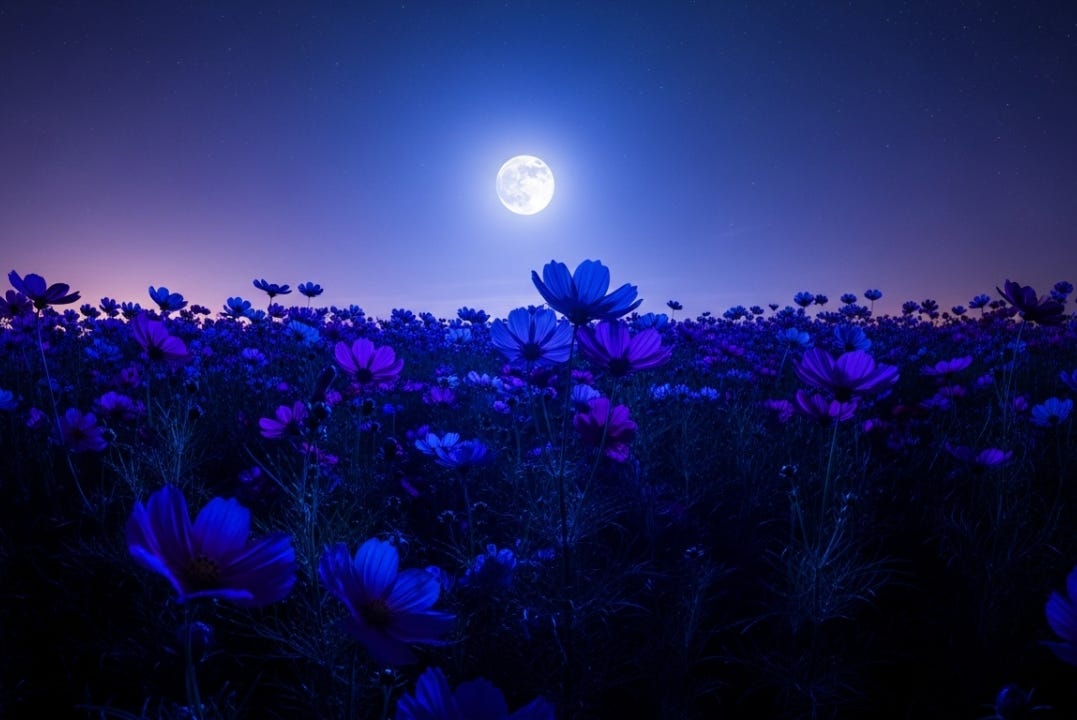
We don’t all bloom at sunrise. Some of us bloom under moonlight.
Permission to Be Rhythmic, Not Rigid
I still respect the science. I also trust my rhythm. I’ve built a life—and a coaching practice—around honoring both. You don’t have to fit the clock; you can create a life that fits you.
So here’s your permission slip: if your clearest thoughts arrive at 11:00 p.m., and your truest rest comes with mid-morning dreaming and soul-deep naps, honor that. Design around it. Lead from it.
Being in moon-mode isn’t a phase. For some of us, it’s home.
IMPORTANT: Consult your doctor about whether BHRT is right for you. Talk to your doctor before taking any supplements. This content is for informational and educational purposes only and is not a substitute for medical care. Please consult your doctor or licensed health practitioner with any questions, and make your own well-informed decisions based on your unique genetics, culture, conditions, and stage of life.