

Menopause and Erotic Identity: What If This Isn’t the End?
Hormonal change as an erotic threshold, not a disappearance.

There is a story most women absorb long before their bodies ever reach menopause. It goes something like this: youth is the peak, desirability is the currency, and menopause is the beginning of the end—of beauty, of relevance, of desire. By the time hot flashes, sleep changes, and cycle shifts arrive, that story is already living in the background, waiting to explain every new sensation as evidence that you are “less than” you once were.
If you’ve felt that fear in your own body—if you’ve wondered, “Is this the end of my erotic life?”—you are not imagining the cultural script. But the script is not the truth. Hormonal shifts are real. They can be intense, disorienting, and disruptive. They are not, however, the end of your erotic identity. In many ways, they are the beginning of a different kind of freedom.
This is the part no one tells you.
Hormonal shifts ≠ loss of erotic self
Perimenopause and menopause bring real physiological changes: fluctuating estrogen and progesterone, shifts in testosterone, changes in vaginal tissue, sleep, temperature regulation, mood, and more. These shifts can affect libido, arousal, lubrication, and how your body responds to stimulation. They can also affect energy, resilience, and emotional bandwidth.
What often happens is that all of this gets collapsed into a single narrative: “My hormones are changing, therefore my erotic self is disappearing.” But hormonal shifts do not erase your capacity for aliveness, pleasure, or desire. They change the conditions under which those things emerge. They ask for adjustments—sometimes in context, sometimes in pacing, sometimes in support—but they do not revoke your erotic identity.
In fact, for many women, the hormonal landscape of menopause removes some of the pressure that shaped their erotic lives in earlier decades. When fertility is no longer the central frame, when the culture’s obsession with youthful attractiveness no longer fits your reality, you have an opportunity—if not immediately, then slowly—to ask a different question: “If I am no longer living for the gaze, who am I as an erotic being now?”
The woman redefining herself outside youth
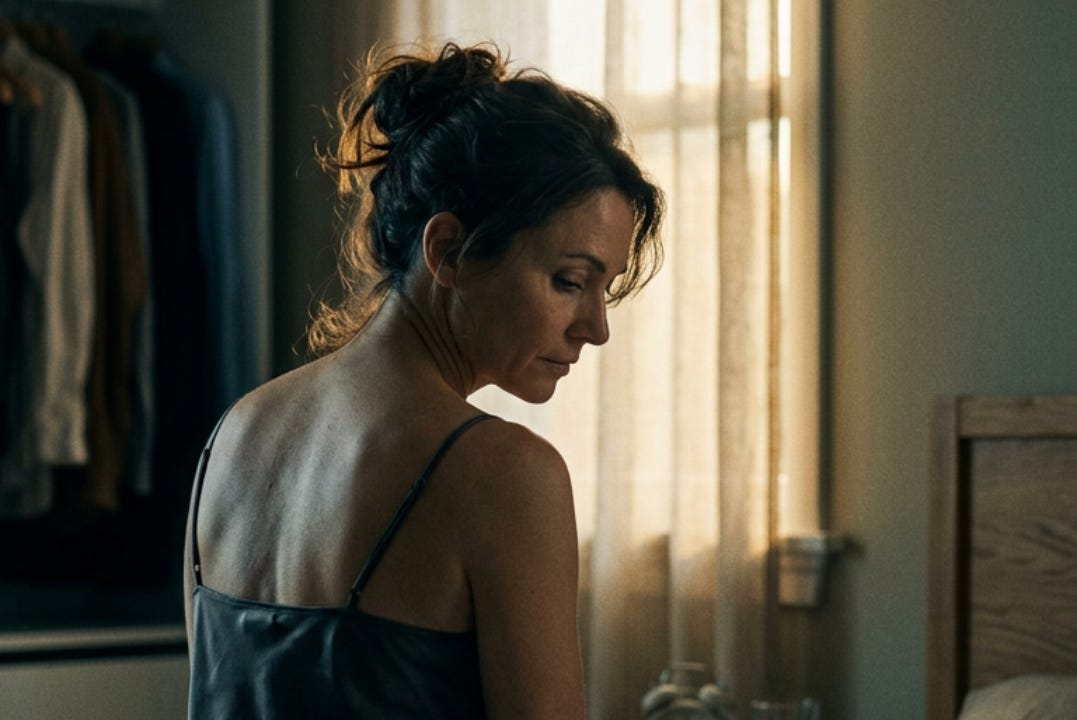
Let’s call her Elise. Elise is 52. Her period has stopped. She has hot flashes, sleep disruptions, and days where her body feels like unfamiliar territory. The internet is full of advice about hormone replacement, supplements, and symptom management. Some of it is helpful. Some of it leaves her feeling like a problem to be solved.
In her twenties and thirties, Elise’s erotic life was organized around being attractive and available. She knew how to dress, flirt, and say yes. She knew how to play the role of “fun, easy, responsive.” She also knew how to swallow her own needs so no one would leave. Desire was less about what she actually felt and more about who she needed to be.
Now, she looks in the mirror and sees a different body. Softer in some places, stronger in others. Lines that weren’t there before. A face that tells the story of the life she has actually lived. Part of her grieves what has changed. Another part of her feels… relief. Relief at not having to compete with twenty-something versions of herself. Relief at not wanting to pour energy into managing other people’s perceptions the way she once did.
Elise still wants to feel alive in her body. She still wants closeness, touch, and—sometimes—sex. But she is far less interested in participating in scripts that require her to be always pleasing, always ready, always “worth it.” She is beginning, slowly, to redefine her erotic self outside of youth and desirability norms. Not because she no longer cares about being desired, but because she no longer wants that to be the whole story.
Menopause as identity reorientation
Menopause is not only a biological transition. It is an identity transition. Roles change: parenting, partnership, work, caregiving. The way you understand yourself in relation to others begins to shift. The question is no longer only “Who am I to them?” but “Who am I to myself now?”
In this sense, menopause is an archetypal threshold. It asks: what identities have been built around being pleasing, fertile, accommodating, or visually palatable? What identities were built around being the young one, the desirable one, the “still got it” one? What happens when those identities no longer feel true, or no longer feel sustainable?
This can feel like loss at first. Loss of the known reflection in the mirror. Loss of predictable responses to arousal. Loss of automatic scripts. But beneath that loss is an opening. If you are no longer organizing your erotic life around who you are supposed to be for others, you can begin to organize it around who you actually are—with this body, in this season, in this life.
Menopause makes it harder to pretend. The body’s tolerance for self-betrayal, over-giving, and under-feeling goes down. The nervous system becomes less willing to tolerate pressure, performance, and the constant outsourcing of self-worth. That can feel like everything is falling apart. It can also be the start of a more honest, internally led erotic identity.
Liberation from the external gaze
For decades, many women have lived under an unspoken rule: your value rises when you are attractive, accommodating, and youthful—and declines as you age. The external gaze (the imagined eyes of others, especially in a culture shaped by the male gaze) becomes a quiet but powerful organizing force. How do I look? How do I come across? Am I still “enough”?
Menopause offers a chance—often an uninvited one—to renegotiate that relationship. The question becomes less “Do they still want me?” and more “Do I still have myself?” This doesn’t mean you stop caring about how you present or how you are seen. It means you begin to experiment with letting your own experience matter at least as much as other people’s perceptions.
Liberation from the external gaze can look like:
Dressing for how fabric feels on your skin, not just for how it reads on Instagram.
Choosing experiences that nourish your nervous system, even if they aren’t photogenic.
Letting your erotic life be shaped by what your actual body enjoys now, not what once earned you praise.
Allowing moments of pleasure that no one else witnesses or validates.
None of this requires you to reject beauty, style, or being seen. It simply shifts the center of gravity from “How do I look?” to “How does this feel, in my body, right now?” That is an erotic question.
Desire becoming more honest
One of the most painful myths about menopause is that it marks the end of desire. For some women, desire does change—sometimes dramatically. For others, it becomes less spontaneous and more responsive. For others still, desire remains strong but asks for different conditions: more time, more safety, more slowness, more presence.
What often looks from the outside like “low libido” is, on the inside, a refusal to participate in dynamics that were never truly nourishing. The body says no to sex that feels like obligation, performance, or self-erasure. It won’t respond to pressure the way it used to. It may not be willing to override pain, resentment, or disconnection just to keep the peace.
This can be frightening—especially in long-term relationships that have relied on old patterns. But it is also honest. Desire in menopause is less willing to be summoned on demand and more insistent on alignment. It wants touch that meets your actual nervous system, not a memory of who you were twenty years ago. It wants intimacy that includes your boundaries, not intimacy that depends on you having none.
From this perspective, menopause is not the end of desire; it is the end of lying about it.
A few questions for your week
As you move through this week, you might experiment with these questions:
Where have I quietly assumed that hormonal change automatically means I am “less erotic”? Where did that story come from?
In what small ways am I already redefining myself outside of youth and desirability norms—even if no one else has noticed?
If I imagined that menopause could be the beginning of a more honest erotic life, what might I be curious about in my body right now?
You don’t need to have perfect answers. You’re allowed to feel ambivalent, relieved, sad, hopeful, or all of the above. The point is not to force a positive spin, but to give yourself permission to ask different questions.
If this is where you are right now
If you are in the middle of this transition—if your body feels unfamiliar, your desire feels confusing, and your reflection is changing—you are not failing at being a woman. You are moving through a threshold that is biological, psychological, and erotic all at once.
Your hormones are changing. Your roles are changing. Your relationship to the gaze is changing. Underneath all of that, your erotic identity is being invited to reorient—from externally defined to internally led, from performance to presence, from being “desirable” to being deeply, actually alive.
You don’t have to love every symptom or every moment to claim that. You don’t have to pretend this is easy. You are allowed to seek medical support, somatic support, relational support—and still hold onto this possibility: menopause is not the end of your erotic self. It may be the first time she has room to fully exist.
This is the fourth layer of June: not pretending hormones don’t matter, but refusing to let them be the final word on your desire, your identity, or your right to live as an erotic being in this stage of your life.
If this writing is landing for you and you want to go deeper in your body — not your head — The Siren Signal is a short, intimate 7-track audio experience for midlife women reclaiming magnetism, desire, and embodied truth. $55. No fixing required.