

Girlhood Breadcrumbs: Unearthing Childhood Clues to Design Your Post-Menopause Life
Mining music, memories, and childhood passions into a purposeful and vibrant Second Act

The Reel that Rewound Time
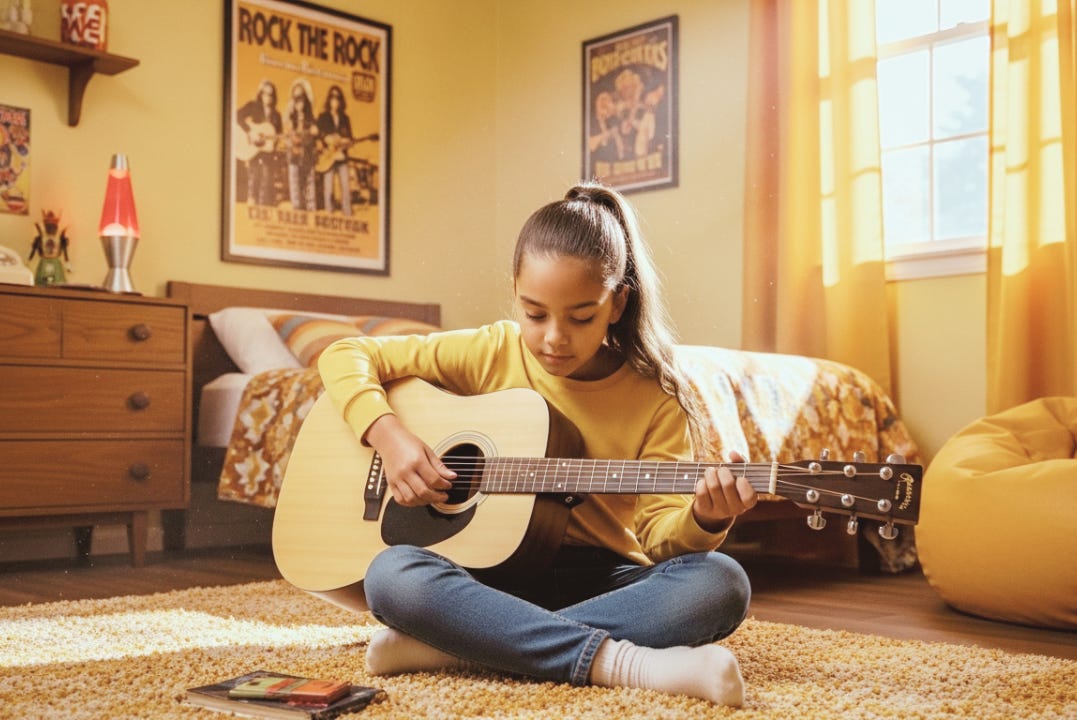
A few nights ago, while winding down with my phone, Instagram slipped me a grainy Winterland clip of Grace Slick snarling “Feed your head!” In a heartbeat I was barefoot in my childhood bedroom, fingers raw from practicing guitar chord changes, while Jefferson Airplane’s song from a few years earlier crackled from the kitchen radio. Jefferson Airplane was a San Francisco Bay Area band. The whole Bay Area in the late 60s and the 70s seemed to hum with possibility. That forty-second reel wasn’t mere nostalgia; it was a wormhole back to a child I’d almost mislaid—and to the passions that still carry the blueprint of who I am now.
Lately my algorithm has queued up everything from The Beatles and Donna Summer to the British-Invasion synth pop of the ’80s. My finger taps the ♥︎ button every time, because each song is another breadcrumb back to myself.
Why Childhood Memories Feel Like Destiny Whispering
Jungian analyst James Hillman called this the acorn theory: we arrive with a tiny seed that keeps nudging us toward the life we’re meant to live, no matter how many adult detours we take. When an old riff or forgotten hobby cracks the shell, we feel the unmistakable click of recognition: Ah, there I am.
Developmental psychologist Dan McAdams adds that we humans craft a narrative identity—an evolving story of who we are and where we’re headed. Midlife is the perfect editorial window: reread or rewrite your opening chapters now, and the whole plot realigns.
Your Midlife Brain Is Rooting For A Sequel
Contrary to decline myths, the brain between roughly 50 and 70 enters what geriatric psychiatrist Dr. Gene Cohen dubbed the liberation phase—a neurologically primed burst of creativity if we dust off dormant interests. Purpose sage Richard Leider shows that when our gifts (natural talents), passions (activities that energize), and values (what matters) intersect, we locate the quickest compass to meaning in the second half of life.
Even five minutes of “inner-child play”—painting, drumming, hopscotch—boosts cognitive flexibility and mood, according to research highlighted by the National Institute for Play. Translation: fun is brain food.
Growing Up Amid The Bay Area’s Cultural Big-Bang
Anyone born in early-1960s Northern California, like me, soaked in the tail end of the Summer of Love. Haight-Ashbury thrummed with psychedelic music, mysticism, and social justice. Even toddlers on tricycles absorbed the era’s radical permission to question authority and mix spirituality with art.
That imprint lingers. Baby Boomers, who once pushed cultural frontiers now pioneer fresh models of purposeful aging (Encore.org calls it “encore purpose”). Gen X women bridge analog childhoods and digital midlives; Forbes recently dubbed Gen X’s renaissance “a revolution, not a midlife crisis.”
Menopause: The Biological Permission Slip
Hormonal upheaval can feel like someone shook the Etch-A-Sketch of identity, yet many clinicians call menopause a Second Spring—a season to shed outdated roles and live from soul-level authenticity. Lower estrogen quiets our chronic caretaking circuitry just enough for long-parked desires to grab the mic—whether that’s restringing a guitar, finishing the eighth-grade novel, or finally learning astrology. Why not?
A Field Guide for the Inner Archaeologist
Step one is a listening party. Cue up three songs you adored between ages 5 and 13. Close your eyes and notice what each one stirs—freedom blooming in your chest, wonder fizzing in your belly, maybe a tear you didn’t know was waiting. Scribble those sensations. Music is stored emotion; it surfaces core values in seconds.
Next comes the artifact dig. Choose one childhood activity—Mass-choir singing, folk-guitar strumming, backyard stargazing, rock polishing, bead-stringing—and give it thirty gloriously messy minutes this week. Do it badly and in private if you must; the point is contact, not performance. Doing so re-opens neural pathways and creative confidence.
Personal Artifacts: I shellacked every interesting rock I found as a kid. That tactile delight grew into a love of palm-stone crystals and their properties.
On a trip to a mall with my older sister in the early 1970s, I wandered into an Occult store and lingered for a while. My sister later found me there and bought me a Zodiac coloring book with intricate designs similar to a Mandala coloring book. That coloring book depicting each zodiac sign might have led to my lifelong interest in astrology.
Breadcrumbs everywhere.
Then map the meaning. Ask yourself: What hunger did this pastime feed—creativity, community, transcendence, simple delight? Notice whether that hunger is thriving or starving today. The answer is a neon arrow toward what your next chapter needs more of. Mapping meaning identifies the through-line that can steer future choices.
Finally, jump ahead. Write a note from your 80-year-old self thanking you for reviving this passion now. Let her describe, in luscious detail, how it reshaped the coming decades. Sealing the intention in future memory turns a wistful idea into a living contract. Writing this cements the long-range payoff and invites a commitment today.
These aren’t parlor tricks; they’re narrative edits that braid past, present, and future into a single, purpose-rich story.
Pulling The Past Into The Present
Midlife reinvention isn’t about manufacturing a brand-new self; it’s an archaeological dig—brushing dust off piano keys and pulling out the sheet music for Beethoven’s Moonlight Sonata, revisiting esoteric books, honoring spiritual curiosities that have waited for your return. Look back, pocket the breadcrumbs, and see where they lead. I’ll have my restrung guitar ready and waiting to hear the childhood treasures you’ve found.